Catégorie : Collaborations

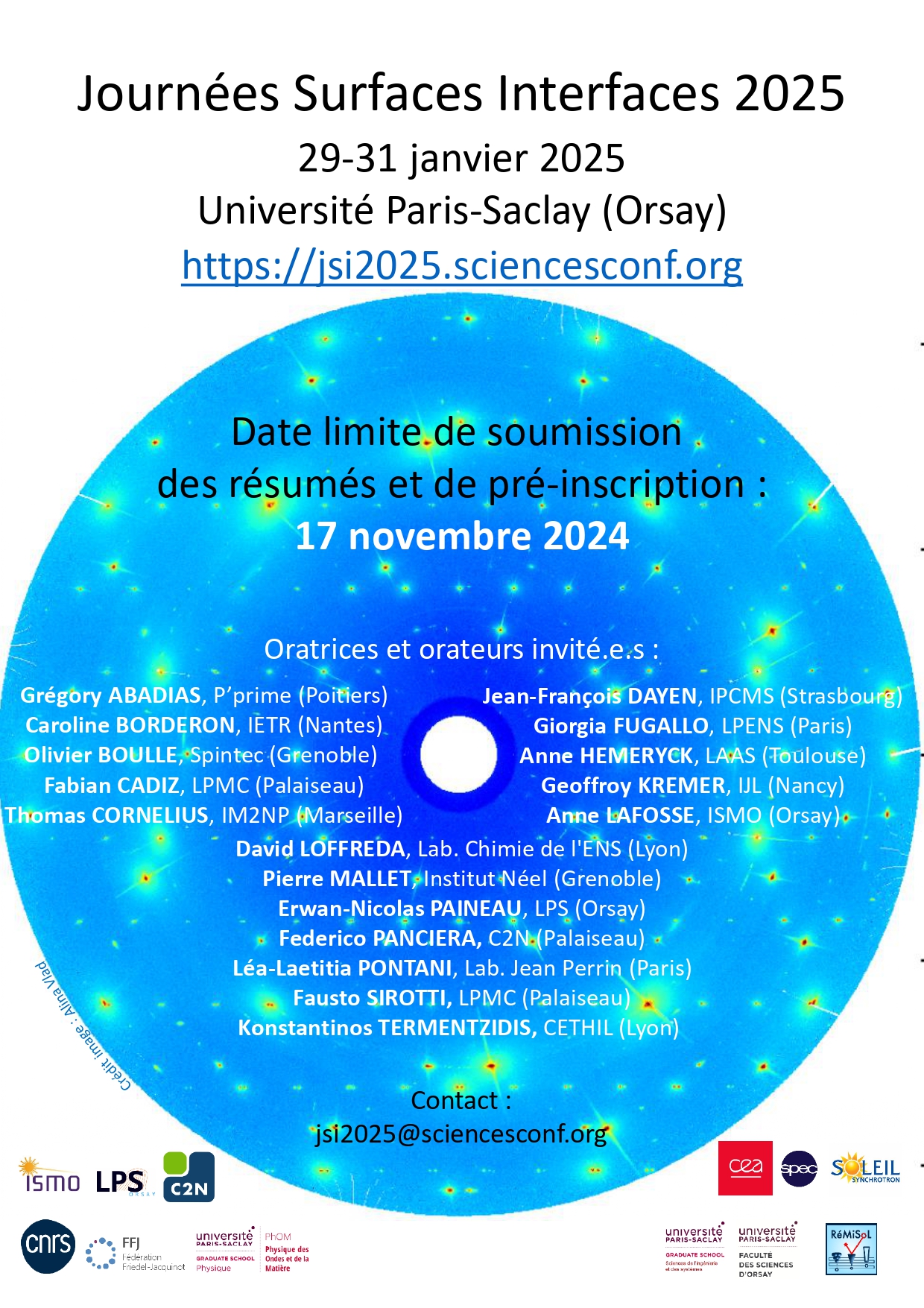
  • Journées Surfaces et Interfaces 29-31 janvier 2025

    Journées Surfaces et Interfaces 29-31 janvier 2025

    JSI2025 Journées Surfaces et Interfaces 2025
    January 29th – 31st, 2025

    LPS – ISMO – Orsay (France)

    Les Journées Surfaces & Interfaces (JSI) mettent chaque année en lumière les avancées dans les domaines de la physique et de la chimie des surfaces et des interfaces. Les thématiques abordées couvrent un spectre très large allant de la structure et la morphologie des surfaces et interfaces jusqu’à leurs propriétés électroniques, électriques, magnétiques, mécaniques ou optiques. Par l’importance des surfaces et des interfaces, par exemple dans les matériaux bidimensionnels et dans les nanostructures telles que les puits ou boites quantiques, les nanosciences trouvent naturellement une place de choix dans ce colloque qui est largement interdisciplinaire et traite des concepts les plus fondamentaux à des applications concrètes dans le monde industriel. Le spectre thématique des JSI couvre également les techniques de croissance et structuration des nanomatériaux, ainsi que les développements instrumentaux liés aux techniques d’analyse et caractérisation, de l’échelle atomique à l’échelle mésoscopique.
  • Ecole de Physique des Houches Du 4 au 29 Août 2025

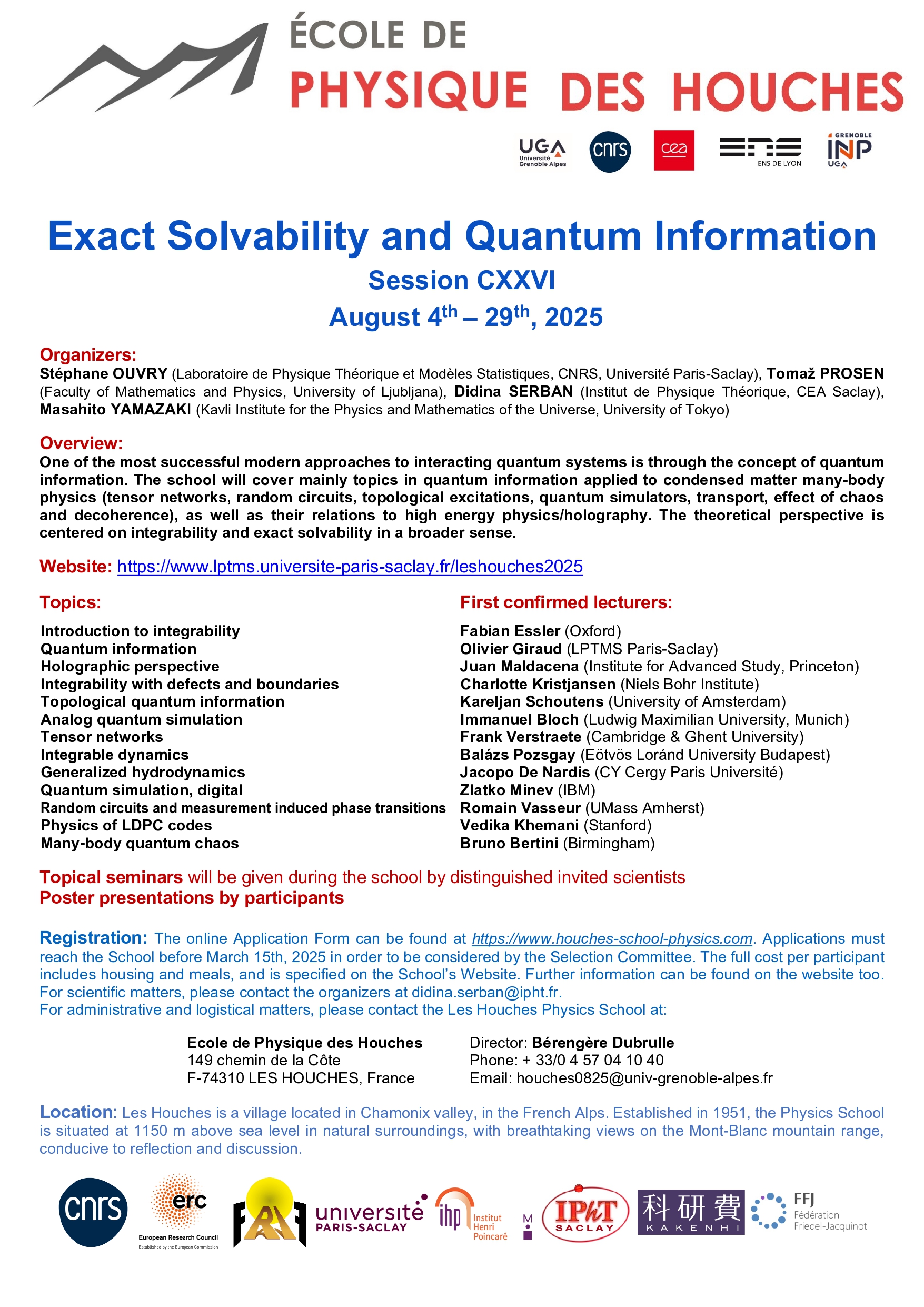
    Ecole de Physique des Houches Du 4 au 29 Août 2025

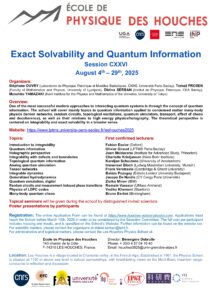
    Exact Solvability and Quantum Information
    Session CXXVI
    August 4th – 29th, 2025

                Ecole de Physique des Houches

    Dear Colleagues,

    We would like to advertise the summer school

    Les Houches Summer School: Exact Solvability and Quantum Information (August 4-29, 2025)

    • Organisers:
    • Stéphane OUVRY, PTMS Orsay
    • Tomaž PROSEN, University of Ljubljana
    • Didina SERBAN, IPhT Saclay
    • Masahito YAMAZAKI,Kavli IPMU Tokyo

    The school will cover mainly topics in quantum information applied to condensed matter many-body physics (tensor networks, random circuits, topological excitations, quantum simulators, transport, effect of chaos and decoherence), as well as their relations to high energy physics/holography. The theoretical perspective is centred on integrability and exact solvability in a broader sense.

    More information can be found on the website of the school

    https://www.lptms.universite-paris-saclay.fr/leshouches2025/

    The deadline for application is March 15, 2025. [Apply now]

    The organisers

  • Participation à l’achat d’un graveur laser à l’ISMO

    Participation à l’achat d’un graveur laser à l’ISMO

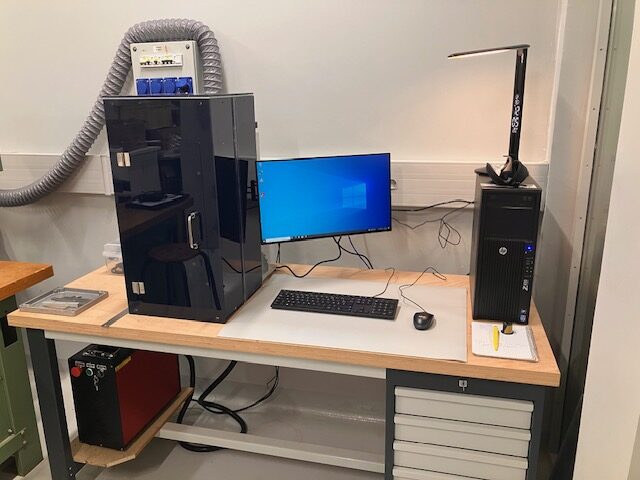
    L’ISMO a acheté un graveur laser avec une aide financière de la FFJ. Ce graveur se trouve à l’atelier mécanique de l’ISMO.

    Il s’agit d’un graveur de marque OMTECH Laser 80W MOPA fibré 1064 nm, ayant une capacité de coupe de 175 x 175 mm avec une épaisseur maximale de 0,5 à 1 mm selon les matériaux à couper. Il est également équipé d’un mandrin rotatif piloté.

    Nos premiers tests ont permis de couper de l’inox de 0,5 mm, du cuivre de 0,3 mm, du tantale de 0,1 mm, du molybdène de 0,1 mm et une feuille d’aluminium de 0,02 mm sur différentes dimensions (15 x 15 mm, Ø 2 x Ø 1 mm).

    Les formats de fichiers acceptés sont les suivants : SVG, AI, PDF, DXF, HPGL, PLT, PNG, JPG, BMP, avec une préférence pour le DXF.

    Si vous avez des réalisations de découpe ou de gravure à faire, veuillez contacter:  Mr Guigand Jérôme  jerome.guigand@cnrs.fr ou Mr Chamaillé Thierry   thierry.chamaille@cnrs.fr

  • Comparative analysis of recirculating and collimating cesium ovens

    Abstract : We have performed a study of several cesium oven designs. A comparison between recirculating (or sticking-wall) and collimating (or re-emitting-wall) ovens is made in order to extract the most efficient design in terms of beam brightness. Unfortunately, non-reproducible behaviors have been observed, and the most often observed output flux is similar to the sticking-wall case, which is the lowest theoretical value of the two cases, with a beam brightness close to 10 18 at. sr −1 s −1 cm −2 . The reason of this universally observed behavior is unclear despite having tested several materials for the collimating tube. Conclusion on possible improved design based on sticking of cesium on several (un)cleaned surfaces is given.

    Raphaël Hahn Thomas Battard Oscar Boucher Yan Picard 1 Hans Lignier 1 Daniel Comparat 1 Nolwenn-Amandine Keriel Colin Lopez 2 Emanuel Oswald Morgan Reveillard 3 Matthieu Viteau 3
    1 LAC – Laboratoire Aimé Cotton
    2 LuMIn – Laboratoire Lumière, Matière et Interfaces
    3 Orsay Physics

  • Substrate influence on transition metal dichalcogenide monolayer exciton absorption linewidth broadening

    Abstract : The excitonic states of transition metal dichacolgenide (TMD) monolayers are heavily influenced by their external dielectric environment based on the substrate used. In this work, various wide bandgap dielectric materials, namely hexagonal boron nitride (h-BN) and amorphous silicon nitride (Si 3 N 4), under different configurations as support or encapsulation material for WS 2 monolayers are investigated to disentangle the factors contributing to inhomogeneous broadening of exciton absorption lines in TMDs using electron energy loss spectroscopy (EELS) in a scanning transmission electron microscope (STEM). In addition, monolayer roughness in each configuration was determined from tilt series of electron diffraction patterns by assessing the broadening of diffraction spots by comparison with simulations. From our experiments, the main factors that play a role in linewidth broadening can be classified in increasing order of importance by: monolayer roughness, surface cleanliness, and substrate-induced charge trapping. Furthermore, because high-energy electrons are used as a probe, electron beam-induced damage on bare TMD monolayer is also revealed to be responsible for irreversible linewidth increases. h-BN not only provides clean surfaces of TMD monolayer, and minimal charge disorder, but can also protect the TMD from irradiation damage. This work provides a better understanding of the mechanisms by which h-BN remains, to date, the most compatible material for 2D material encapsulation, facilitating the realization of intrinsic material properties to their full potential.

    Fuhui Shao 1, 2 Steffi Woo 1, 2 Nianjheng Wu 1, 2 Robert Schneider 3 Andrew Mayne 2 Steffen Michaelis de Vasconcellos 3 Ashish Arora 3 Benjamin Carey 3 Johann Preuß 3 Noémie Bonnet 1 Mauro Och 4 Cecilia Mattevi 4 Kenji Watanabe 5, 6 Takashi Taniguchi 5, 6 Zhichuan Niu 7 Rudolf Bratschitsch 3 Luiz Tizei 1, 2
    1 LPS – Laboratoire de Physique des Solides
    2 ISMO – Institut des Sciences Moléculaires d’Orsay
    3 WWU – Westfälische Wilhelms-Universität Münster = University of Münster
    4 Imperial College London
    5 Université de Tsukuba = University of Tsukuba
    6 NIMS – National Institute for Materials Science
    7 State Key Laboratory for Superlattices and Microstructures, Institute of Semiconductors, Chinese Academy of Sciences

  • Density-tuned isotherms and dynamic change at the superconducting transition in a gate-controlled AlOx/SrTiO3 heterostructure

    Abstract : Two-dimensional electron gases in SrTiO3-based heterostructures provide a platform to study the real-time evolution of the macroscopic state with a variation of the carrier density, and the impact of structural properties on the emergence of the superconducting state. We have explored the isothermal evolution of the electron gas in AlOx/SrTiO3 by measuring the variation of resistance with continuous gate-voltage-controlled tuning of its carrier density. It is seen that condensation of the ordered phase leads to non-monotonic isotherms within the superconducting dome. The timescale for dynamic change following changes in gate voltage is measured across the phase transition. It is found to be tens of seconds near the onset of superconductivity, significantly larger compared to the normal state. Such a large timescale governing the kinetics of the phase transition presumably arises from the strong impact of structural defects and distortions of the substrate on the development of superconducting islands.

    Shamashis Sengupta 1 Miguel Monteverde 2 Anil Murani 2 Claire Marrache-Kikuchi 1 Andrés F Santander-Syro 3 Franck Fortuna 3
    1 IJCLab – Laboratoire de Physique des 2 Infinis Irène Joliot-Curie
    2 LPS – Laboratoire de Physique des Solides
    3 ISMO – Institut des Sciences Moléculaires d’Orsay

  • Acoustic Vibration Modes of Gold-Silver Core-Shell Nanoparticles

    Abstract : Bimetallic Au/Ag core–shell cuboid nanoparticles (NPs) exhibit a complex plasmonic response dominated by a dipolar longitudinal mode and higher-order transverse modes in the near-UV, which may be exploited for a range of applications. In this paper, we take advantage of the strong signature of these modes in the NP ultrafast transient optical response, measured by pump-probe transient absorption (TA) spectroscopy, to explore the NP vibrational landscape. The fast Fourier transform analysis of the TA dynamics reveals specific vibration modes in the frequency range 15–150 GHz, further studied by numerical simulations based on the finite element method. While bare Au nanorods exhibit extensional and breathing modes, the bimetallic NPs undergo more complex motions, involving the displacement of facets, edges and corners. The amplitude and frequency of these modes are shown to depend on the Ag shell thickness, as the silver load modifies the NP aspect ratio and mass. Moreover, the contributions of the vibrational modes to the experimental TA spectra are shown to vary with the probe laser wavelength at which the signal is monitored. Using the combined simulations of the NP elastic and optical properties, we elucidate this influence by analyzing the effect of the mechanisms involved in the acousto-plasmonic coupling.

    Tadele Otomalo 1, 2 Lorenzo Di Mario 3 Cyrille Hamon 4 Doru Constantin 4 Francesco Toschi 3 Khanh-Van Do 1 Vince Juvé 2 Pascal Ruello 2 Patrick O’Keeffe 3 Daniele Catone 3 Alessandra Paladini 3 Bruno Palpant 1
    1 LuMIn – Laboratoire Lumière, Matière et Interfaces
    2 IMMM – Institut des Molécules et Matériaux du Mans
    3 CNR-ISM – Istituto di Struttura della Materia
    4 LPS – Laboratoire de Physique des Solides

  • Electron Dynamics in Hybrid Perovskites Reveal the Role of Organic Cations on the Screening of Local Charges

    Abstract : The large tolerance of hybrid perovksites to the trapping of electrons by defects is a key asset in photovoltaic applications. Here, the ionic surface terminations of CH3NH3PbI3 are employed as a testbed to study the effect of electrostatic fields on the dynamics of excited carriers. We characterize the transition across the tetragonal to orthorhombic phase. The observed type II band offset and drift of the excited electrons highlight the important role that organic cations have on the screening of local electrostatic fields. When the orientation of organic cations is frozen in the orthorhombic phase, the positively charged termination induces a massive accumulation of excited electrons at the surface of the sample. Conversely, no electron accumulation is observed in the tetragonal phase. We conclude that the local fields cannot penetrate in the sample when the polarizability of freely moving cations boosts the dielectric constant up to ϵ = 120.

    Marie Cherasse 1, 2 Jingwei Dong 1 Gaëlle Trippé-Allard 3 Emmanuelle Deleporte 3 Damien Garrot 4 Sebastian Maehrlein 2 Martin Wolf 2 Zhesheng Chen 5 Evangelos Papalazarou 5 Marino Marsi 5 Jean-Pascal Rueff 6 Amina Taleb-Ibrahimi 6 Luca Perfetti 1
    1 LSI – Laboratoire des Solides Irradiés
    2 Department of Inorganic Chemistry, Fritz Haber Institute of the Max Planck Society
    3 LuMIn – Laboratoire Lumière, Matière et Interfaces
    4 GEMAC – Groupe d’Etude de la Matière Condensée
    5 LPS – Laboratoire de Physique des Solides
    6 SSOLEIL – Synchrotron SOLEIL

  • Debonding of a soft adhesive fibril in contact with an elastomeric pillar

    Abstract : The debonding criterion of fibrils of soft adhesive materials is a key element regarding the quantitative modelisation of pressure sensitive adhesive tapes peeling energy. We present in this article an experimental study of the detachment of a commercial acrylic adhesive tape from the top surface of a single micrometric pillar of PDMS elastomer. During an experiment, the pillar and the adhesive, after being put in contact, are separated at a constant displacement rate, resulting in the formation, the elongation and the final detachment of a fibril of adhesive material. A systematic study allows us to uncover power laws for the maximum force and the critical elongation of the fibril at debonding as a function of the diameter of the cylindrical pillar which controls the diameter of the fibril. The scaling law evidenced for the critical elongation appears as a first step toward the understanding of the debonding criterion of fibrils of soft adhesive materials. In addition, viscoelastic digitation at the triple debonding line is observed during detachment for large pillar diameters. The wavelength and penetration length of the fingers that we report appear to be consistent with existing models based on pure elastic mechanical response.

    Aymeric Duigou-Majumdar 1, 2 Pierre-Philippe Cortet 1 Christophe Poulard 2
    1 FAST – Fluides, automatique, systèmes thermiques
    2 LPS – Laboratoire de Physique des Solides

  • Non-Newtonian rheology in a capillary tube with varying radius

    Abstract : The flow through a capillary tube with non-constant radius and where bubbles of yield stress fluid are injected is strongly non-linear. In particular below a finite yield pressure drop, PyPy, flow is absent, while a singular behaviour is expected above it. In this paper we compute the yield pressure drop statistics and the mean flow rate in two cases: (i) when a single bubble is injected, (ii) when many bubbles are randomly injected in the fluid.

    Federico Lanza 1, 2 Alex Hansen 2 Alberto Rosso 1 Laurent Talon 3
    1 LPTMS – Laboratoire de Physique Théorique et Modèles Statistiques
    2 NTNU – Norwegian University of Science and Technology [Trondheim]
    3 FAST – Fluides, automatique, systèmes thermiques